Peppol registration vs GST InvoiceNow submission readiness
Understand what a Peppol Directory result proves, what it does not, and the steps to prepare for invoice-data submission to IRAS.
Free InvoiceNow tools for Singapore SMEs
The GST InvoiceNow requirement is phased from 2025 to 2031, subject to IRAS exclusions. Answer a few quick questions to get your implementation date under the IRAS schedule — and review suggested preparation steps. Free, no signup.
Pick the one that describes your business — your date calculation starts here.
Answer a few questions · No email needed to see your date
How it works
One journey, four steps. No accounts, no jargon.
Answer a few quick questions and get your implementation date under the IRAS schedule — no email needed.
Tell us how you invoice today and see whether your current setup can transmit invoice data to IRAS.
Review preparation steps for your software, connection and customer data, based on your answers.
Run an invoice through our free checker to identify common invoice-data issues before transmission.
See it in action
Seventy seconds on what your date means and what you need to have in place before it.
Every GST-registered business in Singapore has an InvoiceNow start date. Most business owners don't know theirs. And the date isn't the same for everyone.
Knowing your date is step one. Being ready to transmit is another thing entirely. So we built a free calculator. Two minutes, no signup, no email.
Start with how your business is GST-registered. A few quick questions about your filing setup and your supply values. And there's your implementation date, mapped against the IRAS schedule.
Then it tells you where your setup actually stands today: the exact gaps to close before you can transmit anything to IRAS. Most businesses need six to ten weeks. And everyone in your phase starts asking at once.
Find your date free at einvoiceready.sg. Know your date. Then know your gaps.
What being ready means
From your date, your invoice details have to reach IRAS through the InvoiceNow network. Three things need to be in place before that can happen.
IRAS reads invoice details directly, so your system has to produce them in the standard Singapore e-invoice format. The PDF or Word file itself is not a structured InvoiceNow transmission.
You need a Peppol ID registered to your UEN and a service provider sending on your behalf. Software that supports InvoiceNow still has to be switched on and connected.
Sending e-invoices to your customers does not mean IRAS is receiving them. That is a separate step, and it needs to be tested before your date.
Find gaps in your current setup — answer a few questions about your software and invoice process to see suggested preparation steps alongside your date.
Check my status — free →Why businesses use us
Get practical help with invoice records, software setup and testing with your provider.
Worked out from the IRAS schedule and your own GST returns. Check the prescribed periods carefully, especially if you file quarterly.
Use your answers to identify preparation steps, then confirm the details and timeline with your provider.
Review your software, provider connection and invoice data. Contact us to discuss what support fits your business.
Plan around your current software
Some systems already handle this. Some only on certain plans or newer versions. Some cannot do it at all. Tell us your software and version so we can discuss what needs checking with your provider.
Still invoicing from Excel or Word? You have more to do than most, so it is worth starting early. See what's involved →
FAQ
Your date
It depends on your GST registration type, and for existing registrants, your total supplies in calendar year 2025. Existing GST-registered businesses fall into phases between 1 April 2028 and 1 April 2031. New voluntary registrants started from 1 November 2025 or 1 April 2026 depending on when the company was incorporated. New compulsory registrants start from 1 April 2028.
The calculator uses your filing history to estimate your implementation date. No email needed.
For existing GST-registered businesses, IRAS looks at your total supplies for accounting periods ending in calendar year 2025. That is the Box 4 figure on each GST return you filed. The thresholds are S$200,000, S$1 million and S$4 million; higher supplies correspond to later phases.
Quarterly filers get caught out here. Which periods count depends on your filing cycle, so a cycle 1 filer's CY2025 figures start from November 2024.
Yes, in stages, subject to the exclusions set out by IRAS. In-scope GST-registered businesses must submit invoice data to IRAS through the InvoiceNow network from their assigned date. Because it is being rolled out in phases, two businesses on the same street can have dates three years apart.
Yes, and usually earlier than for older businesses. New voluntary registrants have been in scope since 1 November 2025 or 1 April 2026 depending on incorporation date, and new compulsory registrants from 1 April 2028. Being a newer company does not give you more time.
Being ready
Your invoices leave your system in the standard Singapore e-invoice format, travel through a service provider on the InvoiceNow network, and arrive at IRAS. You also need CorpPass set up so your provider can send on your behalf, and your invoice details have to pass IRAS's checks.
An emailed PDF is not itself a structured InvoiceNow transmission.
Not yet. That means the software can do it, not that your account is connected. You still need a Peppol ID registered to your UEN, an active service provider, your customer records updated with their UENs, and a test invoice that reaches IRAS.
Confirm activation and submission setup with your provider.
First, a system that can produce invoices as data, because the network requires structured invoice data rather than the spreadsheet or document itself. After that it is the same as everyone else: a connection, a Peppol ID, and your customer list updated with UENs.
Implementation time depends on your system, provider and testing needs. Start by checking the setup you need.
Yes, both. Your Peppol ID is registered to your UEN and identifies your business on the network. The service provider, sometimes called an Access Point or IRSP, is what carries your invoices on the network. Some accounting systems include this, many do not.
Implementation time depends on your system, provider and testing needs. Ask your provider to confirm the configuration, authorisation and testing steps for your business.
Cost and help
The network is not the expense. Your costs are the software or provider subscription, plus the work to get connected and tested. IMDA offers free packages aimed at smaller businesses, which suit some SMEs and not others.
Eligible businesses may qualify for GST InvoiceNow transition support. Check the current amounts and conditions in official IRAS and IMDA guidance or with your provider.
Yes, that is what we do. We check where you stand, help you choose between systems and providers, get your existing invoice details into the right format, and stay with you through testing until you are live.
We provide implementation support. We are not IRAS, an InvoiceNow-Ready Solution Provider or an Access Point Provider. Contact us to discuss the support your business needs.
No signup is required for the calculator, invoice checker or Peppol lookup. We process uploaded invoices to produce a report. Files and results may be stored, and invoice content may be processed by an external AI provider. Read our privacy information before uploading, and contact us with data-handling questions.
InvoiceNow is Singapore's national e-invoicing network, built on the international Peppol system. PINT-SG is the technical name for the Singapore e-invoice format, and it sets out the details IRAS expects on every invoice sent, such as UEN format, GST handling and currency.
You do not need to know the format yourself. Your software or provider handles it, and our checker tells you if something is wrong.
No signup. Answer a few questions to estimate your implementation date and review suggested preparation steps.
Understand your date, registration and invoice checks before planning your next steps.
Understand what a Peppol Directory result proves, what it does not, and the steps to prepare for invoice-data submission to IRAS.
Work through illustrative examples of the IRAS InvoiceNow phases and learn which registration and supply figures to check.
A practical checklist for missing identifiers, GST totals and invoice structure, with a clear distinction between file validation and live submission.
Insights
Practical insights on InvoiceNow adoption, invoice validation, and common compliance issues.
Transition funding can help eligible businesses adopt InvoiceNow, but a grant does not cover every implementation cost. Understand the support available, check the conditions, and plan the provider setup and data preparation you still need.
By the eInvoiceReady team · Originally published on LinkedIn.
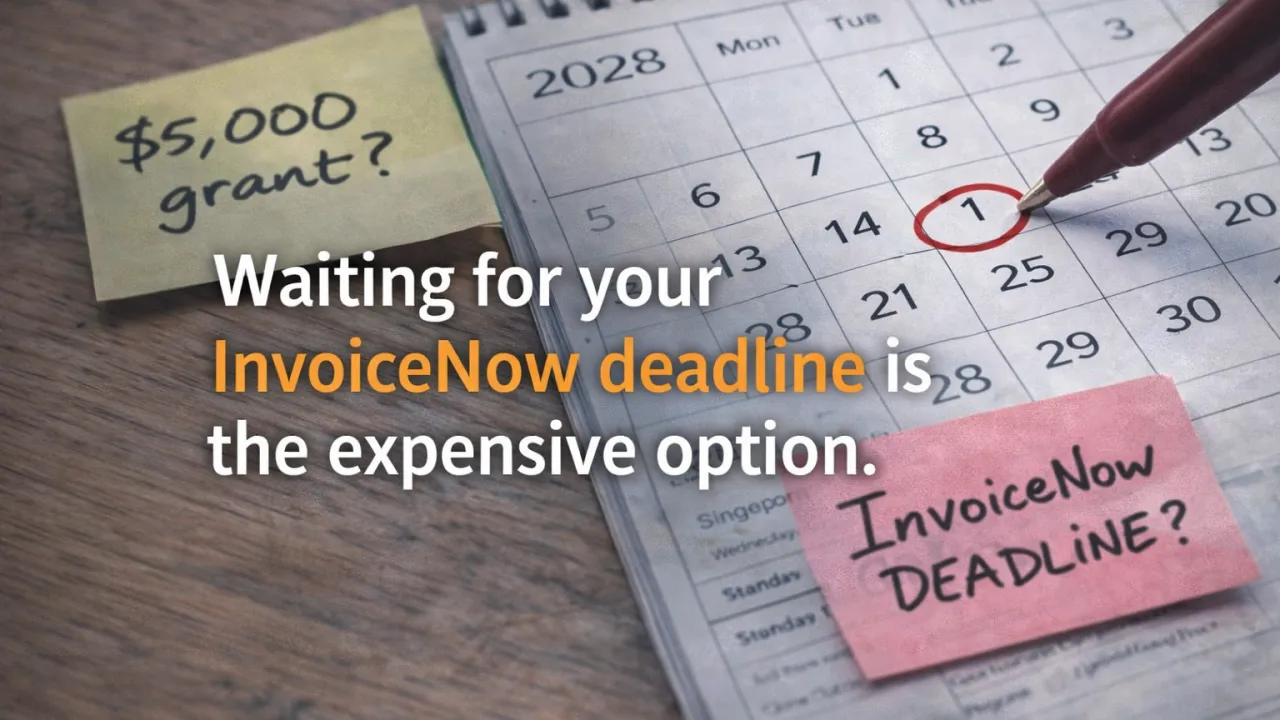
Getting connected is only part of the work. Review GST treatment, customer records, mandatory invoice fields and test transmissions before your implementation date, so preparation is planned rather than left to the final stretch.
By the eInvoiceReady team · Originally published on LinkedIn.
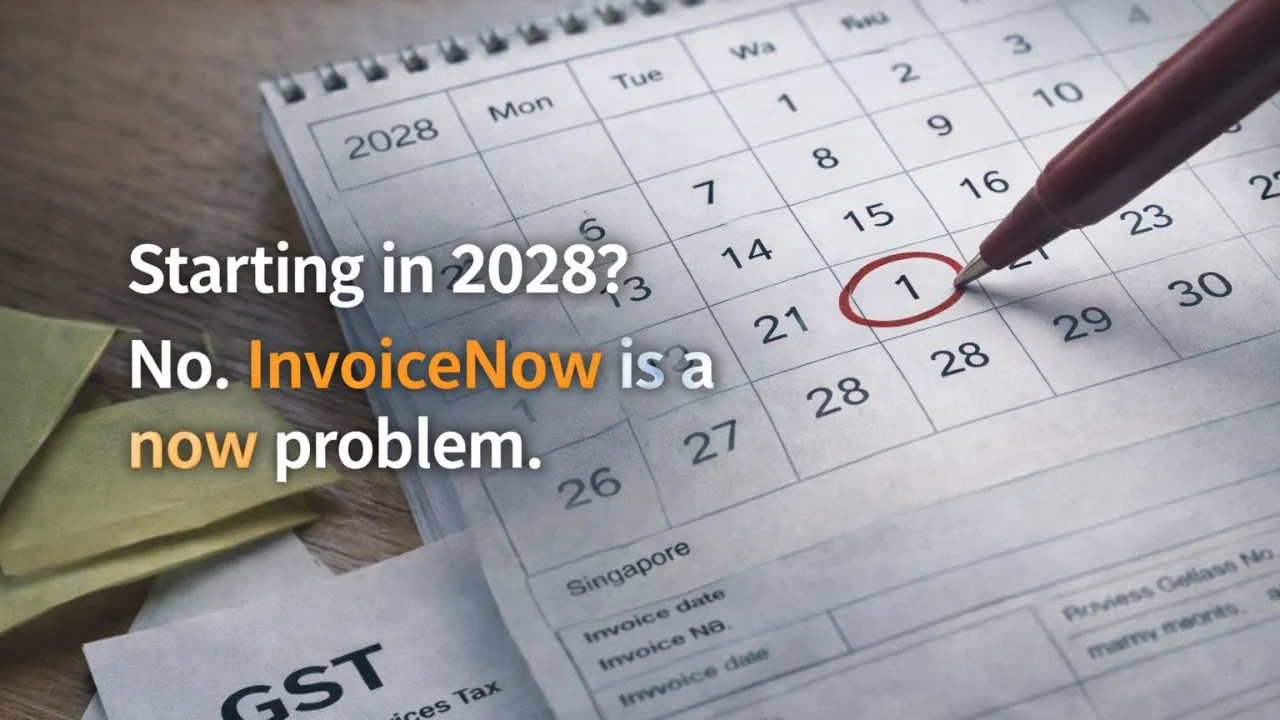
Your GST registration type and relevant 2025 supplies affect when the requirement applies. Work out your phase first, then review the software, provider connection and invoice-data preparation needed before you start submitting to IRAS.
By the eInvoiceReady team · Originally published on LinkedIn.
Tell us about your setup. We'll review it and reply within one business day — no obligation, no sales script.
We help GST-registered business owners, finance teams and accountants understand their implementation date and identify readiness gaps. Start with the free calculator, check Peppol registration separately, then review your invoice data. Our implementation support helps you plan the work with your chosen solution provider.